"On the night of January 27, 2026, violence broke out in the herding hills of Masafer Yatta — that much everyone agrees on. What happened next depends on who’s telling it: a UN dashboard logged it as a 100-strong settler rampage; Israeli military communications describe a Palestinian attack on a shepherd that preceded it. The gap between those two accounts is at the center of a dispute over how the international community measures ‘settler violence’ in Judea and Samaria.
According to the United Nations Office for the Coordination of Humanitarian Affairs (OCHA), around 100 Israeli settlers raided four Palestinian communities, attacked residents with knife-tipped sticks, stole roughly 300 sheep, burned three tons of firewood, vandalized homes and vehicles, and injured six Palestinians.
According to military messages, radio communications, and field material reviewed by The Press Service of Israel (TPS-IL), the incident began when Palestinians from Halawa, one of the communities in Masafer Yatta, attacked a Jewish shepherd with rocks, injured him, and stole his flock. Israeli forces later searched the area and recovered the animals, according to a TPS-IL review of military communications.
Over several months, TPS-IL reviewed incidents listed by OCHA in its humanitarian reporting on Judea and Samaria between January and May 2026, comparing the UN agency’s descriptions with Israeli military accounts, public statements, local documentation, media reports, and interviews with Israeli researchers and activists.
TPS-IL did not attempt to independently verify every incident in OCHA’s database. Rather, it examined cases where available Israeli security accounts, public documentation, or other records raised questions about classification and whether competing accounts were reflected in international reporting...
OCHA’s Settler-Related Violence Dashboard is among the most widely cited international sources tracking violence involving Israelis and Palestinians in Judea and Samaria, with figures referenced in UN reporting, government discussions, and media coverage.
The database uses a broader definition than the phrase ‘settler violence’ may suggest. OCHA defines settler-related violence as incidents involving violence, intimidation, or property damage carried out by settlers, or against settlers, as well as incidents involving Israeli civilians in Judea and Samaria. A settler attacking a Palestinian, a Palestinian attacking a settler, or an incident involving Israeli civilians where responsibility has not been conclusively established may all appear within the same broader category...
A separate report on settler violence published in June by the Jerusalem-based Kohelet Policy Forum found that ‘Between 98-99% of incidents presented on OCHA-oPT’s database refer to confrontations with Israeli security forces, not settlers.’
Questioning OCHA’s methodology, Kohelet wrote, ‘Entirely non-violent conduct, including non-criminal conduct, is counted as settler violence. OCHA-oPT records over 8,000 incidents between January 2016 and April 2023. Among these incidents are alleged cases of Israelis ‘trespassing,’ with no casualties or property damage. Out of 1,704 incidents recorded in East Jerusalem, 1,361 involve Jews visiting the Temple Mount, Judaism’s holiest site, which Palestinians believe they should not be allowed to access. A total of 1,613 incidents in Judea and Samaria involve Israelis hiking or touring land Palestinians claim Jews should be forbidden from.’..."

August 9, 2026
Special Report: U.N. Data Counts Palestinian Terror as ‘Settler Violence’
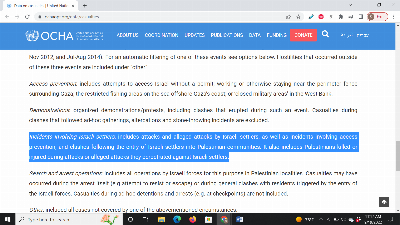
OCHA website (Screenshot)
Date
August 9, 2026
Title
Special Report: U.N. Data Counts Palestinian Terror as ‘Settler Violence’, The Press Service of Israel (TPS-IL)
Author(s)
Pesach Benson and Brett Goodman
Original Source

Back to Top
- © Copyright 2012-2026, Human Rights Voices and respective authors. All Rights Reserved.
-

Source: