"Twenty-five years ago today, representatives from around the world gathered in Durban, South Africa, for what should have been one of the most worthy exercises the United Nations could undertake: a global conference against racism.
Instead, Durban became a watershed in the modern campaign to delegitimize Israel, and helped set the stage for the attitude, language, and vitriol we see directed against the Jewish state and those termed ‘Zionists’ nowadays.
The 2001 World Conference against Racism 2001 included a draft document equating Zionism with racism, targeting Israel alone for its right to exist. Among back-and-forth debates over the exact language used, the idea still stood out as attacking the tiny Jewish state.
The United States and Israel eventually walked out. Jewish participants encountered open antisemitism surrounding the parallel NGO gathering. Israel was accused of racism, apartheid, and genocide, while a conference intended to confront prejudice became consumed by an attempt to revive, in a new form, the old charge that Zionism itself was racism...
Durban did not invent antisemitism or anti-Zionism. Its significance lay in helping to take ideas that had existed at ideological extremes and repackage them in the vocabulary of human rights
.
Twenty-five years later, we have come disturbingly close to completing the circle. Language that helped drive Israel and the United States from a UN conference against racism in 2001 no longer shocks people. Much of it has become part of the everyday vocabulary used to discuss Israel.
That is Durban’s legacy – and why, a quarter-century later, remembering what happened there is still of the utmost importance and worth fighting against."

August 31, 2026
Twenty five years after Durban, equating Zionism with racism has become mainstream
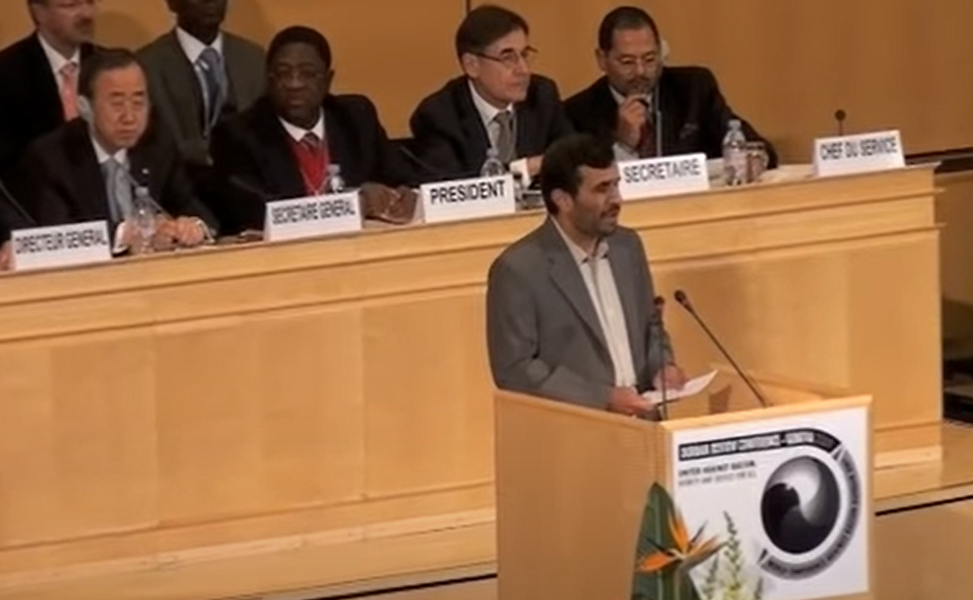
Iranian President Mahmoud Ahmadinejad addressing the 2009 Durban II conference
Date
August 31, 2026
Title
Twenty five years after Durban, equating Zionism with racism has become mainstream, The Jerusalem Post
Author(s)
JPost Editorial
Original Source

Back to Top
- © Copyright 2012-2026, Human Rights Voices and respective authors. All Rights Reserved.
-

Source: