"Bullet holes splattered in every wall bore grim testimony to the onslaught. But what hit me hardest were the bullets that had smashed everyday appliances, such as the microwave oven or the fridge. I had a knot in my stomach as the desperate mothers of the two young women taken hostage led me through the shattered glass and rubble of their daughters’ modest, small single-floor houses.
I tried to remind myself that I needed to avoid feeling too emotional. After all, I was a neutral observer – the role each United Nations special rapporteur is supposed to fulfil. Yet the suffering of these mothers made me realise that we must consider hostage-taking as a form of torture. Not only were the victims themselves likely to be sexually abused, starved, shackled or confined in dark tunnels, but I could now see that – agonisingly waiting to know the fate of their girls, imagining the worst – the mothers and fathers, sisters and brothers of the hostages were also victims of psychological torture.
The whole of Kfar Aza, a kibbutz around two miles from the Gaza strip, was a horrific crime scene. It had been 14 months since 251 men, women and children had been taken hostage from southern Israel. In this kibbutz, more than a quarter of the inhabitants were either dead or had been taken captive.
It had been brave of the mothers, Mandy Damari and Simona Steinbrecher, to agree to let me see the ruined homes of their daughters Emily and Doron. After all, the UN, which I would be seen as representing, had done so little to help them. It had even worsened their anguish by refusing for so long to acknowledge that the attackers on October 7 2023 had conducted not just murders but also sexual molestations, rapes and other horrific violence.
I felt ashamed. I am still outraged that Francesca Albanese, the UN’s special rapporteur on the occupied Palestinian territories, and Reem Alsalem, the UN special rapporteur for violence against women, never formally documented these horrors, despite the growing body of evidence which to most of us is indisputable, but which they dispute (Alsalem has pointed to Israel’s refusal to grant her entry and access as the reason she cannot investigate further). Instead, both have continued to issue a stream of what I regard as one-sided and vitriolic reports, and hard-to-justify excuses for their lack of attention. That, families and returned hostages have told me, only added to their anguish.
My colleagues said nothing, even when the Hamas captors put videos online with Hebrew subtitles showing captives in horrifying scenes. In one, an emaciated hostage was digging what he said in Hebrew was his own grave. It was a form of abusing hostages’ families so that they would put pressure on the Israeli authorities to give in to Hamas demands. That too is a form of torture.
Even after the hostages were brought back, Albanese and Alsalem have failed to give any weight to their first-hand accounts of the tortures and privations they had gone through...
I feel strongly that during the Gaza-Israel war, the UN has been doing itself no favours by obsessively focusing on only one set of abuses – especially as neutrality, independence and impartiality are the cornerstones of a trustworthy UN.
When I issued a report on what had happened on the kibbutzes on October 7, and the slaughter of more than 370 young people enjoying a music festival, only one other special rapporteur had the courage to sign it. The others declined to sign, while several tried to get content in my report suppressed..."

October 19, 2026
As a U.N. envoy, I saw my colleagues’ anti-Israel obsession first-hand
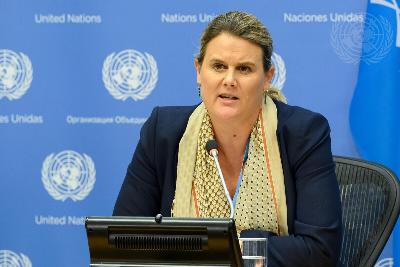
Alice Jill Edwards (File photo courtesy UN Photo)
Date
October 19, 2026
Title
As a U.N. envoy, I saw my colleagues’ anti-Israel obsession first-hand, The Daily Telegraph
Author(s)
Alice Jill Edwards
Original Source

Back to Top
- © Copyright 2012-2026, Human Rights Voices and respective authors. All Rights Reserved.
-

Source: