
Share

Human Rights Voices
While the UN devotes its human rights operations to the demonization of the democratic state of Israel above all others and condemns the United States more often than the vast majority of non-democracies around the world, the voices of real victims around the world must be heard.
U.N. Obsession with Condemning
Israel Instead
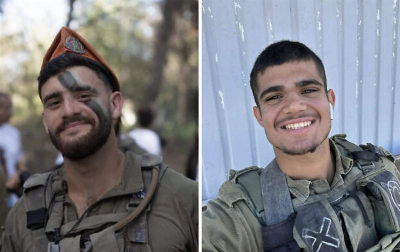
Staff Sgt. Ron Yonatan Roytman (left) and Sgt. Yuval Shai Svilem (right), killed in a shooting attack near Hebron in the West Bank on October 23, 2026. (Photo courtesy Israel Defense Forces)
Palestinian Authority/Gaza, October 23, 2026
2 IDF soldiers killed in Palestinian terror shooting; IDF believes gunmen planned larger attack
Original source
Two Palestinian gunmen opened fire at a military checkpoint near the southern West Bank city of Hebron on Friday, killing two soldiers and wounding three in a gunfight that lasted for more than 20 minutes, before soldiers killed both attackers.
The slain soldiers were named as Staff Sgt. Ron Yonatan Roytman, 23, from Ashkelon, and Sgt. Yuval Shai Svilem, 20, from Hod Hasharon. They both served in the 775th “Ari” Battalion of the Home Front Command’s Search and Rescue Brigade. Roytman was a squad commander.
After conducting a preliminary probe, the Israel Defense Forces said it believed the gunmen were planning to carry out a larger attack against Israeli civilians on Route 35, but realized they would not be able to reach the highway and decided to open fire at the temporary checkpoint instead.
They were identified as Mohammad Jaaba and Firas Jaaba, 27-year-old Hebron residents. They were members of the same family, though as of late Friday morning their exact relationship remained unclear.
It was also not clear if they were working alone or with a larger network. The Hamas terror group — which has a strong presence in Hebron — called the shooting “heroic,” but did not claim responsibility for it.
The two attackers arrived by car at around 7:30 a.m. at a temporary checkpoint set up by the army at the exit to Hebron.
The soldiers stationed there, from the Home Front Command’s 775th “Ari” Search and Rescue Battalion, were conducting routine checks on Palestinian cars leaving the city.
The two Palestinians exited their car on a side street, armed with an assault rifle and a pistol. Using the buildings as cover, they opened fire on the checkpoint, according to the preliminary probe.
The Magen David Adom ambulance service said it treated two of the wounded in critical condition at the scene. They were later declared dead, and the military announced they were soldiers. Three others were described as lightly to moderately wounded and were taken to hospitals in Jerusalem.
Footage from the attack showed a prolonged gunfight between the Palestinian assailants and IDF troops. According to the military, the gunfight lasted over 20 minutes.
One surveillance video showed the gunmen exiting their car, firing at the checkpoint, before retreating. Later, the gunmen were seen climbing over a fence in the area.
“Take cover, come to the ambulance, it’s bulletproof,” a medic could be heard calling out in one clip, as gunshots rang out.
“We haven’t yet managed to extract the wounded; there’s been active shooting for more than 20 minutes,” he could be heard saying in another video.
Photos published by the AFP news agency showed the moments of the attack. AFP said their Hebron-based photographer was en route to another assignment when he witnessed the gun battle break out at the checkpoint.
The deputy commander of the Ari Battalion, a company commander, and an officer of the Paratroopers Brigade’s 101st Battalion who was stationed nearby rushed to the scene, flanked the two gunmen on the side street, and killed them.
The IDF and Shin Bet were investigating whether the two gunmen acted alone or were part of a larger terror network and received funding and direction from a terror group, the army said.
The preliminary probe found no specific warning of the attack. The IDF was already on heightened alert ahead of Tuesday’s national elections and amid violence by extremist settlers against Palestinians.
Following the shooting, the IDF said it launched a raid in the Hebron area. Troops were operating at the homes of the two gunmen, the military said, amid plans to demolish them.
Hebron and other Palestinian villages and towns in the area were under full closure, according to the military.
“This was a serious attack. The troops’ swift action prevented an even more serious attack and further harm to civilians and security forces,” IDF Chief of Staff Lt. Gen. Eyal Zamir said during an assessment with officers on the shooting.
Zamir noted that “a large quantity of ammunition was found in the vehicle in which the terrorists arrived at the scene of the attack, which was intended to be used to carry out a larger-scale attack.”
He ordered that preparations be made for additional forces to be deployed to the Central Command if required...
- © Copyright 2012-2026, Human Rights Voices and respective authors. All Rights Reserved.
-

Source: