
Share

Human Rights Voices
While the UN devotes its human rights operations to the demonization of the democratic state of Israel above all others and condemns the United States more often than the vast majority of non-democracies around the world, the voices of real victims around the world must be heard.
U.N. Obsession with Condemning
Israel Instead
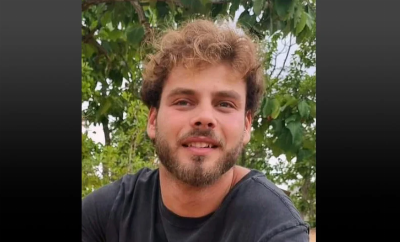
Alon Ohel, taken captive by Hamas terrorists on October 7, 2023 from the Nova rave. (Courtesy)
Palestinian Authority/Gaza, December 2, 2025
How Palestinian terrorists treated Jewish hostage Alon Ohel: “Chained like a monkey, eating like a dog”
Original source
Alon Ohel, who was held hostage for two years in Gaza, said he was intentionally starved and “chained like a monkey” for the vast majority of his captivity but still made a conscious decision to survive.
“Anyone who wasn’t there won’t be able to understand it. You’ve never experienced hunger, you’ve never been chained for a year and a half. Chained like a monkey, eating like a dog. There, you’re not a human being, you’re an animal,” he recalled during an interview with Channel 12 that aired on Monday.
Ohel was abducted from the Nova music festival near Kibbutz Re’im on October 7, 2023, as thousands of Hamas-led terrorists stormed southern Israel to kill some 1,200 people and take 251 hostages, sparking the war in Gaza.
Ohel, now 24, was taken captive along with Hersh Goldberg-Polin and Eliya Cohen. Goldberg-Polin was murdered in captivity, while Cohen was released in a hostage deal in January 2025.
In his interview, Ohel recalled his capture, his first painful days as a hostage, repeatedly coming close to being killed by IDF fire, the bond he built with fellow hostage Eli Sharabi, and what it was like to spend so many months alone after those he was held with were released.
Capture
When the Hamas-led attack began, Ohel fled the Nova music festival into a roadside bomb shelter along with Aner Shapira and Hersh Goldberg-Polin and over two dozen other people.
“I really wanted to leave as soon as the rockets subsided, but they never did. What’s more, we started hearing Kalashnikovs. I kept wondering to myself, ‘Where’s the army? We were just waiting for our deaths,” Ohel told Channel 12.
As Shapira tossed out grenade after grenade that terrorists were throwing into the bomb shelter, Ohel turned to him and said, “Everything will be okay.”
“He didn’t even look me in the eye. He was a madman, and he saved us all,” Ohel said of Shapira, who managed to toss back seven grenades before the eighth exploded and killed him. Goldberg-Polin tried to follow suit, but he held onto the grenade for too long, it exploded and he lost his left arm. Ohel said he thinks it was shrapnel from that grenade that severely damaged his own left eye.
The terrorists subsequently threw Ohel, Goldberg-Polin and others into the back of a pickup truck and took them into Gaza.
His entire body was in searing pain. Shrapnel had also struck his shoulder and arm. But already then, Ohel told himself, “No matter what, I choose life.”
He and the other hostages he was with were taken to a hospital, outside of which a mob of angry Gazans awaited them. Ohel scoffed at the idea that there were any innocent bystanders in the Strip that day.
That night, he was given a sleeping pill and woke up the next morning unable to breathe due to the pain. He and the other hostages were stitched up with shrapnel still inside them and with no anesthesia. They were barred from speaking. “I sat there for two weeks with people I had no idea who they were,” Ohel said.
As he recalled the experience, Ohel’s whole body began to tremble.
“They take you from your life in an instant. I’m a 22-year-old kid. What do I know about life? In just one second, they tore me out of my reality and put me in hell.”
‘Father-son bond’
For the first 52 days, Ohel was held aboveground. Then — after a weeklong ceasefire in November 2023 — he was taken underground, where he met fellow hostages Sharabi, Goldberg-Polin, Almog Sarusi and Uri Danino.
Ohel and Sharabi were separated suddenly one day from the others. Ohel was sure that the latter three were being released, but they were actually taken to another tunnel where they were eventually executed in August 2024 by their captors, who sensed Israeli troops approaching.
Ohel was left with Sharabi, Or Levy and Cohen. He built a particularly close relationship with Sharabi, 53, who became a father figure to him.
“From the very first moment, he and I connected,” he said.
Ohel recalled a moment when he lost his temper over the lack of food they were given and punched a wall, which may have broken his hand. Sharabi was there to comfort and hug him. “It was a father’s hug.”
“He would hold me and lift me up,” Ohel continued. “He carried himself and me on his back.”
He broke down in tears when he recalled how Sharabi would talk about his two daughters, who they didn’t know at the time had been murdered on October 7, along with Sharabi’s wife.
Ohel and Sharabi promised each other in captivity that they would survive and remain sane for their families waiting for them back in Israel.
Sharabi taught Ohel how to maintain his sanity, even as they were intentionally starved.
“You tell yourself, ‘Eventually you’ll get used to the hunger,’ but no. It’s a pain all over your body – all of the time. You look like a skeleton,” Ohel told Channel 12...
How he survived
Ohel, an accomplished pianist, said that music played a critical role in helping him survive and stay sane. He would sing to himself until his captors told him to stop. When he told them he played piano, the Hamas fighters didn’t know what the instrument was. Ohel said that as religious Muslims, they were prevented from listening to music or dancing.
At one point, Ohel’s captors took out a laptop and showed him a picture of an Israeli at a protest in Tel Aviv’s Hostages Square holding a placard with his picture and a piano in the background.
“I told myself, ‘Now there’s really no way I’m giving up. If people who I don’t even know are taking to the streets and holding up my signs, who am I to even consider giving up, even for a moment? There’s no way,'” Ohel recalled.
After his release in October this year, Ohel visited Hostages Square, where he played on the yellow piano that his family had placed there during his captivity.
The song Ohel chose to play during that visit was “A Song With No Name,” which he hummed to himself regularly in captivity.
Despite the indescribably difficult circumstances, Ohel said, he told himself in the first moments in captivity that he would make it out alive and return home.
Left alone
However, as a young male, Ohel came to realize that he would be among the last hostages to be freed from Gaza.
In January 2025, he was forced to say goodbye to Sharabi, Levy and Cohen, who were released in the war’s second hostage deal.
Ohel admitted to being shattered and terrified about being left alone, though Sharabi tried to assure him that it would only be a matter of days until he was freed as well.
But the hostage deal collapsed after its first phase of six weeks, and Israel resumed the war in March.
While being on his own presented new challenges, Ohel benefited from no longer having to share his food with fellow hostages. His captors also began to feed him a little more, in an apparent effort to minimize international blowback over how starved hostages like Sharabi looked upon their release.
Ohel was even given a Harry Potter book to read, which he went through countless times. It was the sixth book of the series, in which the character Albus Dumbledore dies at the end. “I read that part once, and that was it. I said, ‘I can’t. This is not the end for me.'”
It was also during that time that his captors began to sexually harass Ohel. When he was periodically allowed to take a shower, one of his captors insisted on scrubbing Ohel himself. Ohel recalled trying to move away when the Hamas member would wash his private parts, but the captor would insist on doing so. “Luckily, it didn’t go any further,” he said.
Release
Ohel was eventually moved to a different tunnel, which he later learned was in northern Gaza, as Hamas sought to use him as a human shield to prevent the IDF’s operation to take over Gaza City earlier this year.
During the transfer, he met fellow hostage Guy Gilboa-Dalal. The two of them had served in the Navy together and recognized each other immediately. Hamas would later publish footage of the encounter in what was the first clip showing Ohel alive since his captivity.
The pair were later told to write letters to their families.
“To my family — Mom, Dad, (and siblings) Ronen and Inbar, I miss you and love you so much. I’m fine. I’m alive and breathing. I hope to see you soon. You are the strength that has helped me to continue to survive here — what keeps me here day after day in this never-ending nightmare. I’m thinking about our vacations together, and the ones to come,” Ohel wrote.
He broke down recalling the letter.
In October, Izz al-Din al-Haddad — who had become Hamas’s Gaza military leader after all of his superiors were killed in the war — appeared in the tunnel where Ohel was being held to inform him that another hostage deal had been reached.
From there, everything happened quickly. He was handed over to the Red Cross, which brought him to the IDF.
Ohel recalled being overcome with appreciation for the soldiers who had left their lives and families back home to fight on his behalf.
When he finally reunited with his family, Ohel made a point of keeping his composure so as to assure them that he was still sane and healthy.
Shortly thereafter, however, he began to break down, particularly upon learning of the fate of Sharabi’s family.
“For two years I was a dead person,” Ohel told Channel 12. “I prayed to this light that someone would save me. But I also discovered that I am strong, that I can do anything, and that I am not a victim.”
Ohel still has a long road to recovery ahead, including surgeries to repair his shoulder and the vision in his left eye.
“I am not looking for self-pity. I have been through what I have been through. I am taking it and growing — continuing to learn and develop. I am going to conquer the world,” he said proudly.
- © Copyright 2012-2026, Human Rights Voices and respective authors. All Rights Reserved.
-

Source: