
Share

Human Rights Voices
While the UN devotes its human rights operations to the demonization of the democratic state of Israel above all others and condemns the United States more often than the vast majority of non-democracies around the world, the voices of real victims around the world must be heard.
U.N. Obsession with Condemning
Israel Instead
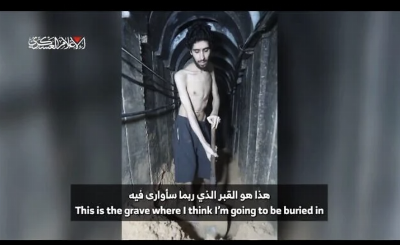
Hamas-held hostage Evyatar David filmed digging what he says he fears will be his own grave in a tunnel in Gaza, in a Hamas propaganda video that his family cleared for publication on August 2, 2025.
Palestinian Authority/Gaza, July 31, 2026
Ex-hostage Evyatar David details struggles with PTSD, a year after Hamas forced him to dig own grave
Original source
The Times of Israel
Former hostage Evyatar David, who spent over two years in Hamas captivity in Gaza, revealed that he was suffering from post-traumatic stress disorder that brings him back to the tunnels and the daily battle for survival he faced.
David, who has barely spoken publicly since his October 2025 release, recounted part of his ordeal on Channel 12’s “Uvda” program aired Thursday evening, alongside his good friend and fellow hostage Guy Gilboa-Dalal. David is remembered for being starved by his captors and forced to dig his own grave as part of a propaganda video published by the Palestinian terror group.
“After more than two years in captivity, I was sure that after what I’ve been through, nothing would be beyond me,” David wrote on social media before “Uvda” was broadcast.
“I went to dance at the Nova [festival], and in one moment my life was turned upside down. I was kidnapped and put in a dark tunnel, and all I thought about was surviving another day, and another day, until I returned home,” he says.
“In the moments when I almost broke down, what kept me afloat were thoughts of my parents, family, friends, and the hope that nobody would give up on me,” David recounts.
“When I returned, I received more love than is imaginable. People whom I didn’t know told me they had prayed that I would come back,” he continues. “After everything I saw there, the Nation of Israel reminded me that there is good in the world as well.”
“But slowly, I understood that even when you return home, not everything returns with you. I am dealing with PTSD and flashbacks. There are moments when I am in a safe place, surrounded by people I love, but my head still goes back there. I understood that surviving captivity is one thing, but complete rehabilitation is a different battle,” the 25-year-old writes.
“I am not writing this to be pitied. I am writing because I want to win this battle as well. My dream is to be rehabilitated, to marry, to start a family and truly return to normal life. But the rehabilitation journey is long, and friends and family have started a crowdfunding campaign for me so that I can focus on healing,” he said, asking the public to donate and share (Hebrew link).
“Again, thanks for fighting for me.”
‘The grave I think I’m going to be buried in’
Speaking with Channel 12, Gilboa-Dalal and David recounted their abduction from Nova and the conditions of their captivity in Gaza, with the latter describing the experience of digging his own grave in a Hamas tunnel.
“They starved us throughout the captivity,” David said. “The real serious starvation began about three months before the video. We were already in a situation of not speaking in order to conserve energy.”
The footage, released in early August last year and filmed a few days prior, sparked outcry and became one of the most harrowing images of the plight of the hostages kidnapped by Hamas in the terror group’s October 7, 2023, attack.
In the video, a skeletal David held a shovel and described how he had not eaten for a few days and had dug a pit in a tunnel.
“This is the grave I think I’m going to be buried in,” he said in the video. “Time is running out. You are the only ones who can end this.”Hamas-held hostage Evyatar David filmed digging what he says he fears will be his own grave in a tunnel in Gaza, in a Hamas propaganda video that his family cleared for publication on August 2, 2025.
In the “Uvda” interview, David recalled smelling food being eaten by his captors as they took him to film the video.
“They tell me, come, we’re going somewhere else for a moment,” he recalled. “On the way, we pass by their big room… I was blindfolded, and I remember the smell of tea they were preparing and cakes, and I could hear them chewing. And a skeleton is walking by them now, and they’re enjoying cake and tea.”
His captors then showed him a pit and instructed him to dig, he said.
“Then we get to this place, and I see a half-dug pit, and they say, ‘Here, take this, here’s a shovel, go in, this will be your grave,” David said. “I dug this grave. It was close to impossible to do physically. I told myself in my head, it could be that if I’m really going to die, I’ll go lay down in this pit.”
He added, “Think of what it is to dig your own grave. Maybe I am going to die of hunger?”
David was released in October along with the rest of the surviving hostages upon the signing of a ceasefire deal in Gaza.
“I was freed from captivity, but the things I went through there continue with me,” David said. “How people know me, through this terrible video, is so different from how I look today, but in the end that skinny guy with the spoon digging a grave is still with me.”
- © Copyright 2012-2026, Human Rights Voices and respective authors. All Rights Reserved.
-

Source: