
Share

Human Rights Voices
While the UN devotes its human rights operations to the demonization of the democratic state of Israel above all others and condemns the United States more often than the vast majority of non-democracies around the world, the voices of real victims around the world must be heard.
U.N. Obsession with Condemning
Israel Instead
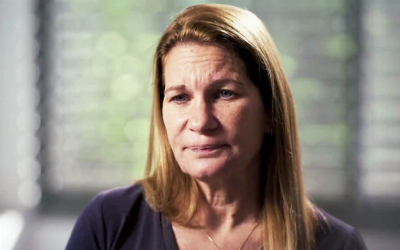
Mira Shoshani, a senior Shin Bet agent whose daughter was murdered on October 7, 2023, during the Hamas-led attack on Kibbutz Kfar Aza (Screenshot of interview broadcast on Channel 12)
Palestinian Authority/Gaza, September 17, 2026
Israeli mother describes how she heard daughter die on Oct. 7
Original source
Mira Shoshani, who was the most senior woman in the Shin Bet security agency at the time of the October 7, 2023, attack on Israel, has described in an interview how she spoke to her daughter in her final moments before she was murdered by terrorists on that day, and her amplified sense of guilt due to her job.
Shoshani, whose family lived in Kibbutz Kfar Aza near the Gaza border, and who like others was forced to hide at home as terrorists ravaged Israeli communities, was head of a Shin Bet division responsible for senior Hamas members abroad. In an interview broadcast on Channel 12 Wednesday night, she spoke of her daughter Staff Sgt. Ofir Shoshani‘s death and the regrets she still has at not being able to save her.
Due to her senior role, and her knowledge of highly sensitive information, Shoshani also spoke of the concerns she and other defense officials had throughout that day that she would be captured by Hamas.
“I thought a lot about what I would say if I were taken captive. It crossed my mind many times that if I were taken captive, it should be clear to everyone [in Israel] that they need to kill me. They shouldn’t try to rescue me; they need to kill me.”
“Unacceptable helplessness,” Shoshani said as she recalled speaking with her daughter, who had been shot. “Unable to help my girl. This is what I had been doing my whole life, and I couldn’t manage to help my girl.”
Shoshani joined the Shin Bet at the age of 24 and rose through the ranks until she commanded her own division. She and her husband Shai had made a home in Kibbutz Kfar Aza, which lies on the border with the Gaza Strip, where they raised three children, two boys and a girl.
Terrorists murdered 80 people at the kibbutz during the attack, and destroyed dozens of homes. Ofir was among the victims.
“I thought I understood Hamas; I was part of the concept,” she said, referring to the widely held belief among Israeli security officials before October 7 that Hamas was deterred from launching a major attack on Israel.
Though the couple was aware of the risks of living so close to the border, they chose to remain, she said, explaining, “This is my kibbutz and community. You live in a dilemma all the time.”
“I knew Haniyeh very well,” she said, referring to Ismail Haniyeh, the late head of Hamas’s political bureau, who lived in Qatar and was assassinated by Israel in 2024. “I knew when he got up and when he went to sleep, what he did during the day, and with whom he met.”
On the day of the attack, the family was on the kibbutz, with Ofir in her own housing unit in the community’s neighborhood for the younger generation, and the Shoshanis at home with their youngest son. The eldest was away in the army.
When the Hamas attack began at 6:29 a.m. with a massive missile attack, the mother and daughter conversed via text message. Husband Shai stayed on the phone with Ofir while Mira contacted her Shin Bet command center.
At first, Shoshani thought it was an isolated case of a terror cell crossing the border that would soon end, and when she spoke with the command center, amid the confusion, she was initially told by a person on the phone that the unfolding attack was just a drill.
Once she realized a significant attack was underway, Mira tried to summon soldiers to the kibbutz. When military units eventually arrived at around 9:15 a.m., she believed the incident would soon end. However, by then scores of terrorists had invaded the kibbutz, and gun battles would rage for days before the IDF could reestablish control.
At 10:15 a.m., Ofir told her parents, “I’ve been shot.”
Shai went out to try to rescue Ofir, but was waylaid by terrorists marauding through the community. He was injured and eventually rescued by Israeli soldiers.
Mira, meanwhile, remained on the phone with Ofir.
“She said that [her injuries] hurt and asked where the [Israeli] forces were. She didn’t cry or scream; she spoke calmly, quietly,” Mira recalled.
Mira assured her that Israeli forces were on their way and urged her to put a tourniquet on her wounds.
“She said it hurts and she couldn’t do it,” the mother recalled.
Eventually terrorists broke into Ofir’s home.
“I heard the terrorists in her room breaking things. I told her to play dead. At 11:46, she texted, even though she was still on the line with me, ‘Mom, I love you.’ I saw the message and told her not to say that — the forces were on their way.
At that point, the call was cut off.
“I was afraid to call because I didn’t know whether her phone would ring or was on silent. I was afraid they would hear her. I wrote to her: ‘Ofiri, answer me.’ She never answered again, but as far as I was concerned, she was alive, and all I needed now was to get her out of there,” she said.
As the hours passed, Mira could hear the fighting getting closer to her own home, and she moved into her safe room with her young son.
“That was the first time that I thought we were in danger. I thought to myself in my heart that this is what it feels like to be scared to death,” she said.
Her son was quiet, hugging his mother and telling her not to cry.
As Israeli security forces worked to regain control of the kibbutz from the terrorists, Mira repeatedly told those she was in contact with to send forces to the neighborhood where Ofir lived. However, the Shin Bet had already determined that Shoshani, as a senior figure in the agency and due to the information she held, was a priority for rescue, and soldiers were told to head her way first.
Forces finally reached her at 7:30 p.m. Mira decided to pack a bag for her son and then remain at the kibbutz to help with directing forces.
She eventually did leave her home after security forces pleaded with her to do so. By then, some of those who rescued her already realized there was little chance that Ofir had survived, but did not say anything.
Mira headed straight to a Shin Bet command center in Ashkelon and tried to work from there.
“I was finished; my body hurt. All that interested me was for [rescuers[ to get to Ofir,” she said. “I needed someone to get to her.”
However, forces were still unable to reach the neighborhood. It would take 48 hours after the Hamas attack began until security forces could get to the Young Generation neighborhood.
By then, Mira understood that her daughter had died, and she waited at the command center until someone would come to confirm the terrible news.
“It felt like an eternity,” she said. Then someone arrived who had reached Ofir’s room on the kibbutz, as well as the head of her department, who wanted to tell Mira himself.
“They approached, and that was how life ended,” she said of the traumatic change she has felt since Ofir was killed.
Mira said she still cries every day over what happened, and still can’t forgive herself.
“The girl who was my whole world is no more. I felt that I had failed, that I didn’t manage to save her. I failed in my life’s mission.”
Among her daughter’s possessions, she found a notebook, and in it a list of articles of faith that Ofir had written on the role of being a commander.
Using that as a basis, she has established the Ofir Center for Leadership, in honor of her daughter.
“I wanted to do something significant that would memorialize her,” Mira said. “Something that is alive, that connects between what I am and what she is.”...
- © Copyright 2012-2026, Human Rights Voices and respective authors. All Rights Reserved.
-

Source: