
Share

Human Rights Voices
While the UN devotes its human rights operations to the demonization of the democratic state of Israel above all others and condemns the United States more often than the vast majority of non-democracies around the world, the voices of real victims around the world must be heard.
U.N. Obsession with Condemning
Israel Instead
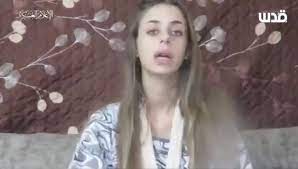
Vide of Mia Schem while in captivity (Screenshot)
Palestinian Authority/Gaza, June 28, 2026
Locked up…forced to witness rape and slaughter…tortured: October 7 hostages’ horrifying accounts
Original source
Mia
Schem was shot in the arm at point-blank range by a Hamas gunman,
losing five litres of blood as she was dragged by
terrorists into Gaza.
There,
she was held like an 'animal in a cage', and told she would never return to her
home in Israel, but would instead be married off to a man in the Palestinian
enclave.
Omer
Wenkert was beaten with a metal rod, sprayed with pesticides and lost 40
per cent of his body weight while suffering for 505 days in an underground
tunnel.
He
began to crave death and even did a ritualistic ceremony where he bid farewell
to his family, accepting his fate.
Hadar
Sharvit overheard the screams of Israeli women being raped by Hamas militants
at the Nova festival site, and still remembers the smell of hundreds of burnt
bodies.
Hiding
from terrorists only a few metres away from her, she apologised to her father over the phone, telling him she
loved him — sure that her murder was only a few seconds away.
On
October 7, 2023, thousands of Hamas gunmen breached the southern border
of Israel, slaughtering 1,200 people, mainly civilians,
and taking 250 others hostage in the single-worst slaughter of Jews since the
Holocaust.
Over
two years after the terrorist attack that triggered the Israel-Gaza war,
October 7 survivors are attempting to psychologically heal by recounting the
traumatic memories that still keep them up at night.
Mia Schem
Recounting
her story at the Nova Exhibition in London on Thursday evening, Schem, 24, routinely had to take pauses in her speech as
she became choked up with tears.
'I
don't want to die now. I don't want to die now,' she remembers repeating to
herself after Hamas militants stormed the music festival, killing almost 400 revellers and taking 44 others hostage.
When
trying to flee, she was shot in the arm, and felt her hand 'almost disconnect'
from her body.
She
watched in horror as Hamas soldiers took her friend, 28-year-old Elia
Toledano, captive to Gaza with his arms tied behind his back.
That
was the last time she would see Toledano, who was later killed by
militants.
When
taken to the Strip herself, Schem described how
a terrorist screamed: 'Welcome to Gaza!'
Without
proper medical attention, her wound was allowed to deteriorate, after doctors
attempted to tie her hand to a 'piece of plastic'.
'They
treated me like an animal in a cage,' she says, recounting how she spent
days locked in a room without windows, with a guard watching her every
move.
'They
didn't give me any medicine... my body was broken, it's a miracle that I have a
hand, I don't know how I survived 55 days without treatment,' she adds.
She
was tormented by her guard's wife, who she describes as 'crazy' and cruel,
depriving Schem of water for days at a time.
'I
thought maybe I will never return back to Israel,' Schem
says, adding: 'One of the terrorists came to me and told me: "You
will never go back home. You stay here. You marry here."'
She
was forced into recording a video for Hamas where they told her what to say, but, knowing her mother back in Israel would see the
footage, she tried to communicate the truth of her experience with her eyes.
'My
body was broken but my soul was strong like it never was before. I felt like my
soul disconnected from my body because I didn't feel the pain. I imagined my
mother all the time, and how the first meeting would be. I imagined my
future wedding,' Schem says, describing how
she maintained mental strength.
Before
her release on November 30, 2023, after 55 days in captivity, Schem was transferred from a house to an underground
tunnel, where she was put in a cage with a number of other women.
'I
couldn't stand up,' Schem says, recounting how
there was 'no air and no light'.
She
admits that it is only by speaking to the audience on Thursday that she has
finally begun 'healing' from the experience, because up until now she hasn't
been in touch with the pain — perhaps in an attempt to suppress the
memories.
'It's
something that I know will be with me all my life. But now I need to learn how
to deal with the trauma...
'Sometimes
I'm up, sometimes I'm down, but I will never give up on myself.'
Hadar Sharvit
When
the music suddenly stopped at the Nova festival at 6.29am, Sharvit thought there must have been a problem with the
sound system.
A
few seconds later, she began seeing rockets and enormous smoke plumes in the
sky.
Speaking
to the Daily Mail, she described how she and her friend, Shalev Navarsky,
attempted to flee the festival by car, but they soon got stuck in a
traffic jam and were forced to escape on foot.
They
ran through a forest, but terrorists soon closed in on them, forcing the pair
to hide under a bush.
'I'm
lying down, with my face on the ground. The terrorists are ten metres from me, and they're shooting,' she
says, recounting how the sound of grenades and gunshots rang in her ears.
Throughout
the ordeal, Sharvit was texting her 65-year-old
father, who demanded that she send him her location, so he could come and help
her reach safety.
But Sharvit, a maths teacher,
was too scared to send her father the address, worried that he might
endanger himself.
Instead,
she decided to accept her fate and wish him farewell.
'I realised that probably, I need to say goodbye, and that I
love him. He's telling me to stay calm, to buy some time, and that he's coming
to find me. So he was on the way, and at that moment, I couldn't say no,
because I needed help.
'All
the police officers that were around me got killed. I realised,
in that moment, that I'm alone. He was telling me buy some time, to stay
calm, saying: "I'm on the way to you." And again, I say: "I'm
dying, I’m sorry, I love you."'
After
running through a forest, the friends took cover under a citrus tree in a
nearby orchard, yet before long the area was swarmed by Hamas militants
too.
From
her hiding place, she overheard Israeli women being raped by gunmen.
'Everywhere,
people were screaming, begging for their lives, getting murdered, and being
abused by terrorists,' she says. 'The smell was unbelievable. Burnt bodies,
blood, fire.'
Eventually,
the orchard began to erupt in flames, so Sharvit
and Navarsky decided to run to the nearest
army checkpoint in an attempt to save their lives.
'I
saw all the things that I heard. Parts of bodies on the ground, smoke
everywhere, terrorists dead and alive,' she says.
'Everything
was just like a horror scene that Hollywood would never create itself.'
From
the army checkpoint, Sharvit managed to call her
father, who was about to get into his car to come and find her.
When
they reunited, 'he held me so tight, I thought he would break my bones', she
says.
Seeing
him again was surreal, because Sharvit had already
accepted she wouldn't make it home from the massacre alive.
'I
was preparing myself to die,' she says, recalling how she did a 'death
meditation' from under the citrus tree, where her life flashed before her eyes.
On
returning home, Sharvit's PTSD was so severe
that she felt like a 'three-year-old baby' again, with every knock on the door
reminding her of a bomb or a grenade.
She
wasn't able to sleep with the light off, nor was she able to drive. She has
also struggled with her memory, feels anger, and copes everyday with the strain
of survivor's guilt, knowing that so many others died.
Nevertheless,
she has found solace and community with fellow survivors. 'For me, to stay
alive after this, it's a gift,' she says.
Omer Wenkert
In
June 2024, Wenkert reached his breaking point
in Hamas captivity.
Alone,
starved and abused in an underground tunnel, Wenkert
had just spent his 23rd birthday the preceding month in the company of no one
except violent terrorists.
He
had been kidnapped as a hostage at the Nova festival massacre, where his
22-year-old close friend, Irish-Israeli Kim Damti, was killed by grenades as
the pair hid together in a bomb shelter.
That
June, after over eight months in captivity — 197 days of which he spent
totally isolated — Wenkert felt like a ‘broken
vessel’.
‘They
completely ripped my soul. There was nothing left inside me anymore… Even if
they had, that second, teleported me to my house, to my family, I felt that I
would never be a normal person again.’
For
the next six hours, he began a ‘goodbye ceremony’, first to himself, and then
to his brothers, his sisters and his parents, telling them out loud that he was
sorry and that he would not be returning home alive.
But
miraculously, Wenkert eventually conjured the
internal power to survive, and was released after 505 days of torment on
February 22, 2025.
Speaking
to the Daily Mail, the 25-year-old described the 'humiliation' and torture he
suffered at the hands of his Hamas captors, including being beaten with an iron
rod, having pesticides sprayed all over his body and his eyes, and losing more
than 36kg due to food deprivation.
Before
he was kidnapped and his life changed forever, Wenkert
was the manager at restaurant Nina Bianca, south of the central Israeli city of
Rehovot, working up to 400 hours in a single month.
Twelve months
before the Hamas-led invasion of southern Israel, Wenkert
had lost his best friend in a separate terrorist attack. That year, partying
became part of his healing, his ‘rehabilitation’, where he felt he could ‘clear
the soul’.
In a
spur-of-the-moment decision, he convinced his friend Damti
to attend the Nova music festival, with the pair purchasing their tickets at
3.30am on October 7, 2023.
A
few hours later, at 6.30am, only an hour after arriving at the festival, the
pair heard the first bombs, and rocket sirens began blaring.
Wenkert got a text from his mother, asking if he was afraid. In the
last message he sent to his family before disappearing into the Gaza Strip, he
told her he was terrified.
After
escaping the festival site in a car, the two friends rushed to a roadside bomb
shelter along Route 232 with about 40 others. Only 12 made it out alive.
Hamas
found the shelter and threw grenades inside, forcing Wenkert
to hide behind bodies to survive. But when he realised
the terrorists were preparing to burn everyone inside, he stepped outside,
where gunmen captured him and threw him into a pickup truck en
route to Gaza.
For
the next 505 days, Wenkert didn’t see daylight
once.
His
first 54 days were spent underground with Liam Or, who had been abducted from
Kibbutz Re’im, along with several Thai foreign workers.
‘It
was very hard. We barely ate, we barely drank, we didn’t get a shower — even
once — and we were unable to stand up, to move,’ he says.
‘I
was terrified, one hundred per cent of the time.’
When
his cellmates were freed in the first hostage deal in November 2023, Wenkert was transferred to another tunnel, around 90cm wide
and 8-9m long, beginning his period of total isolation.
Without
the comfort of fellow captives, Wenkert was sure he
would ‘get crazy, real fast’.
For
the next 197 days, Hamas guards visited him twice every 24 hours, each time for
only a total of one minute, delivering him half a pita bread and a litre of water.
He
was allowed to wash himself — using water from a two-litre
bottle — only once every 60 days.
‘That’s
it. They don’t talk to me, they don’t let me talk to
them. Nothing.’
Over
time, Hamas grew frustrated at their inability to secure a deal with Israel,
and they let out their anger on Wenkert.
The
showers stopped, and the humiliation began.
‘Every
two or three days, the guard told me to stand up, go to the edge of the tunnel,
and he sprayed bug spray on me — on my eyes, my mouth, all over my body, on my
mattress, my spoon, my toothbrush, my plate.
‘It
was May 22, 2024, my 23rd birthday, and he hit me with a huge iron rod… he just
ran straight into me, hit me directly on my head, then my shoulders, my legs,
my toes.’
The
beatings went on for more than a week, multiple times per day.
By
June, tortured and alone, Wenkert craved the peace of
death.
‘For
three days, I was literally broken,’ he says.
‘Lying
on the ground on my back, looking at the ceiling, my eyes open. I didn’t feel
anything, I didn’t do anything, I stopped thinking. I was just completely
empty, for I had nothing inside me anymore.’
Then
came a turning point.
On
day 197, after Wenkert was ready to give up, fellow
Israeli hostages Tal Shoham, Evyatar David and Guy
Gilboa Dalal were transferred to his tunnel.
‘I
looked at them like my lifeguards,’ he says, adding: ‘They really saved my
life.’
Together,
the four ‘became a family’, playing cards, chess, and talking about television
and their favourite films to pass the time and keep
each other sane, even while surviving the unimaginable.
‘We
were still human, even there, underground, as terrorists guarded us in
captivity,’ Wenkert says.
‘We
created a human life in the most inhumane conditions… it was hard, but we made
our unit so powerful that nothing could break us.’
He
was released on February 22, 2025, after 505 days in Hamas captivity, as part
of a hostage release-ceasefire deal between Israel and the terror group
that collapsed after its first phase.
Describing
the day of his release, Wenkert said Hamas militants
forced him and the other hostages into wearing 'stupid uniforms' and blindfolds
as they were finally escorted out of the tunnel network.
Together,
they sang the song Shir Lamaalot, 'A Song of Ascents', seconds before
leaving their underground cell.
'It
felt like victory spread all over my body,' he says, remembering the experience
of seeing daylight again. At the time, he gestured a 'V' symbol to the sky with
his index and middle finger as he stood on stage.
Eventually,
he and the other hostages were transferred to the Red Cross, and were finally
reunited with their families in Israeli hospital.
'I
met my mother and my father for the first time,' he says. 'A moment I can't
describe with words.'
- © Copyright 2012-2026, Human Rights Voices and respective authors. All Rights Reserved.
-

Source: https://hrvoices.org/victim-voices/locked-up-forced-to-witness-rape-and-slaughter-tortured-october-7-hostages-horrifying-accounts/?view=print